
The Autoritratto- (Self-Portrait) Confrontation with the self -
Updated: Jun 19
The Self-Portrait as Self Discovery; an essay- Brian Keeler
Showing oneself from behind, in a painting is not the usual way we would think of as an ideal pose for a self-portrait. The self concealed in mystery is the seeming result of this pose- with no visible characteristics of the face, physiognomy or character, let alone soul or individual expression of the eyes or other features. Yet this is the way that one of the most iconic paintings in all of western art shows the artist Jan Vermeer in his large self-portrait titled, The Allegory of Painting. The title is telling, as it alludes to much more than just a record of the person and suggests this painting encompasses the act of painting as a model for the process of art. The artist is shown as he portrays a woman in the role of Clio, the muse of history. Therefore the artist is part of an historical continuum and this also elevates the practice of painting to a more ennobled status. History painting was once considered the highest form of art- as it endeavored to impart a moral lesson.
I had Vermeer's painting in mind when I painted the self-portrait below. I am painting from a nude, but out of doors instead of in a domestic interior. The setting for this work was in Italy, just outside of Todi in Umbria. It was done from photos taken of me with this project in mind. I also painted studies from this spot en plein air. In fact my students were gathered around also painting the woman. And one of my students, broke her ankle right behind me while I was painting, (she missed a step looking into sunlight).

Above- "Under Umbrian Clouds" a self-portrait 26" x 30," oil on linen, inspired by a Vermeer with a similar pose with model.

Above- Vermeer's painting from 1666-1668- Thought to be a self-portrait, painting a woman posing as Clio, the muse of history.

Above- "Drawing Time," a self-portrait in an interior. The title refers to the double entendre, it being a time for drawing and the act of sketching the metronome- a measurement of time.
I have just been working on a self-portrait, the first in several years. The process brings in a confrontation with the self: our idea of who we are and the ego or that elusive at times current of memories, impressions, reflections, concepts and ideas. Paul Brunton, the philosopher and author of many books on spirituality, has lots to say on the subject. Not on the self-portrait per se but on the levels of awareness and ego. In fact, there was an entire volume compiled after his death as part of a series of notebooks titled, The Ego- From Birth to Rebirth.
Considering Brunton and all the contemplative practices of many traditions from western monasticism and religious leaders to eastern traditions like Buddhism and Zen meditations, we are not short of offerings on the subject. Still, when painting, it seems well-advised just to get down to the act of painting itself and be unencumbered by the theories and ideas. Here are two passages from Brunton's book.
The ego finds every kind of pretext to resist the practice required of it.
And this also from P.B. -
It requires a subtler intelligence or a simpler heart to realize that a man's best course is to put his force at the service of a worthier cause than the mere perpetuation of a a faulty ego. The parable of the Prodigal Son then assumes an intimate meaning for him. While reading it again, he may derive astringent wisdom from remembering all the unpleasant consequences of the lower ego's activities. These are too often like a blind man tremblingly feeling his way and moving from one mishap to another making one false step after another.
Well said- the two examples given above have expressions in famous paintings, namely Rembrandt's, Return of The Prodigal Son and Pieter Bruegel's Allegory of the Blind leading the Blind.
But painting is more than just an exploration of the ego. We painters are involved in many other aspects of the craft and sometimes with aspirations and the pursuit of a vision. In fact, it could be said that the act of painting offers an alternative to this reductive quality of self.
My current self-portrait brings up some of these considerations. Vermeer in particular is referenced, as he has been in other works of mine- overtly and by inference. In this work, set in the interior of our home, an 1865 Victorian outside of Ithaca, there is an open door behind that reveals another room, a kitchen with light coming through the windows. This infilade effect (a series of rooms), is a device that Vermeer used as did others of the Dutch Golden age, like Gabriel Metsu, DeHoogh and Gerhard ter Borch.

The drawing stage- An "x" in the upper section- to the right of the portrait incates the vanishing point.
Above the work in progress- "The Sketch Artist."

Above- "An Interior- Sketching Time," oil on linen on panel, 26" x 30." There is a diagonal amature in this painting fomed by two upward slants from the dog to the portrat, and from the Rembrandt through the marble head. It is contrasted with opposing slants formed by the arm and sketch book.
In this painting (now in progress- shown above) I have included some of the antiques and objects
collected by Linda over the years. A marble bust of a Renaissance era woman in a unique type of bonnet with large curling side flaps is prominent. She is in repose, as if meditating or silently listening to music or immersed in her own thoughts, with eyes lowered. The creamy warm-hued marble shows the delicacy of form and the overhead light brings out her features and garments with a chiaroscuro of deep shadows and light. Next to her is a tote bag, purchased at the Rembrandt House Museum in Amsterdam several years ago. It just happened to be on the bench. This bag has a self- portrait of Rembrandt in an especially wild expression as if hooting at a salacious revelation heard at a tavern in Amsterdam. His eyes are wide, his lips parted a tad and pursed. This line drawing is amazingly from an etching not bigger than a postage stamp. It is part of a series of small self-portraits done from a mirror. The amount of articulation in a few deft lines is quite remarkable- the skill in draftsmanship is there for us to appreciate.
This expression of Rembrandt is contrasted to the stoic pose of our new dog, a white-furred mix of Great Pyrenees and Anatolian shepherd. Her profile or 3/4 view is facing toward the Rembrandt. To the left is a Pegassus also in white marble positioned to my left. And there is a section of one of my brushy landscape paintings from 30 or so years ago to the right- a painting of a scene near Hollenback, PA called Zurn's Pond.
There is also a photo on the wall to the left- it is a poster from the movie, the Tango Lesson- and it reflects our interest in dance. And in that photo of the two dancers, above them is a large painting of two figures that seem to echo the pose of the tangeros. I believe it is a biblical theme of Jacob Wrestling with an Angel. This could suggests how we wrestle with our own issues and egos.
The perspective in this work is evident in the receding wood panels in the ceiling that draw toward a vanishing point to my right. This vanishing point is always important in Vermeer's work as well. But the intervals of space in this work formed by the door jam, windows and other vertical divisions is part of the compositional underpinning. These intervals are also intrinsic and essential in Vermeer's work. I have made several sketches of his work in museums over the years where I have been concerned with these aspects and relationships.
This current work is being done with the use of several photographs as reference. And the objects are introduced sometimes after the work is started. For example, our dog Nella was included after the work began. And the door behind was opened at a later stage as well. In other works major revisions are made. In a Vermeer at the Met in NYC, the woman asleep while seated at a table covered with a kilim likewise had a figure of a man in the doorway that was removed. This was revealed through modern photographic methods that show the underpainting stages.
The vanity aspect and objectivity inevitably come up. In this work, I am aware of my aging. So there is some recoil or flinching. But then I consider those wonderfully honest portrayals of Rembrandt when he depicts himself with his face sagging, some age spots perhaps, thinning grey hair and paunch. The 20th century British painter Lucian Frued seemed to revel in his own ageing process. We also come to note the inclination to portray ourselves in a flattering light. His brutal portrayal of others and delight in all kinds of bodily anomalies was perhaps his hallmark.The opposite is not necessarily a solution either, for it could be just ego coming in through the back door. This is looking for the worse or to exaggerate the ravages of time as if in caricature.

Above- A self-portrait (of the author) in pastel from 1985- done from a mirror.

Above- A charcoal drawing - a self-portrait (of the author) done from a mirror- 1985
The portrait, as with the still lifes of the Dutch Golden age or with any era of painting, brings in the warning or moralizing aspect of these genres. The inherent admonition is to align oneself with the eternal and not be seduced by the temporal. As with perishing flowers and fruit of a still life we can apply the same approach to these self-portraits.
.
Furthermore, vanity is thought of as a false support for a false idea, pandering to misconceptions or even propaganda or political hyperbole. The other side as exemplified in Rembrandt's self-portraits done over his entire lifespan, was a study, a search, and a curious investigation. So this approach to the self-portrait is aspirational in the sense of an inquiry rather than as a screed or polemic to further an agenda. In other words, it is the opposite of vanity.
It is hard to resist the example of hubris and abuse of these ideas if not flagrant vanity,- even self- delusion. These are the risible examples of the current occupier of the White House who has presented himself as a supercomic hero or in gilded statues or more recently with Chirst-like attributes.
The title of this essay is autoritratto- which is the Italian word for self-portrait. It suggests agency, as with autonomous or self-willed or self-directed actualization. Rather than a passive acceptance, the Italian term indicates a more proactive involvement.
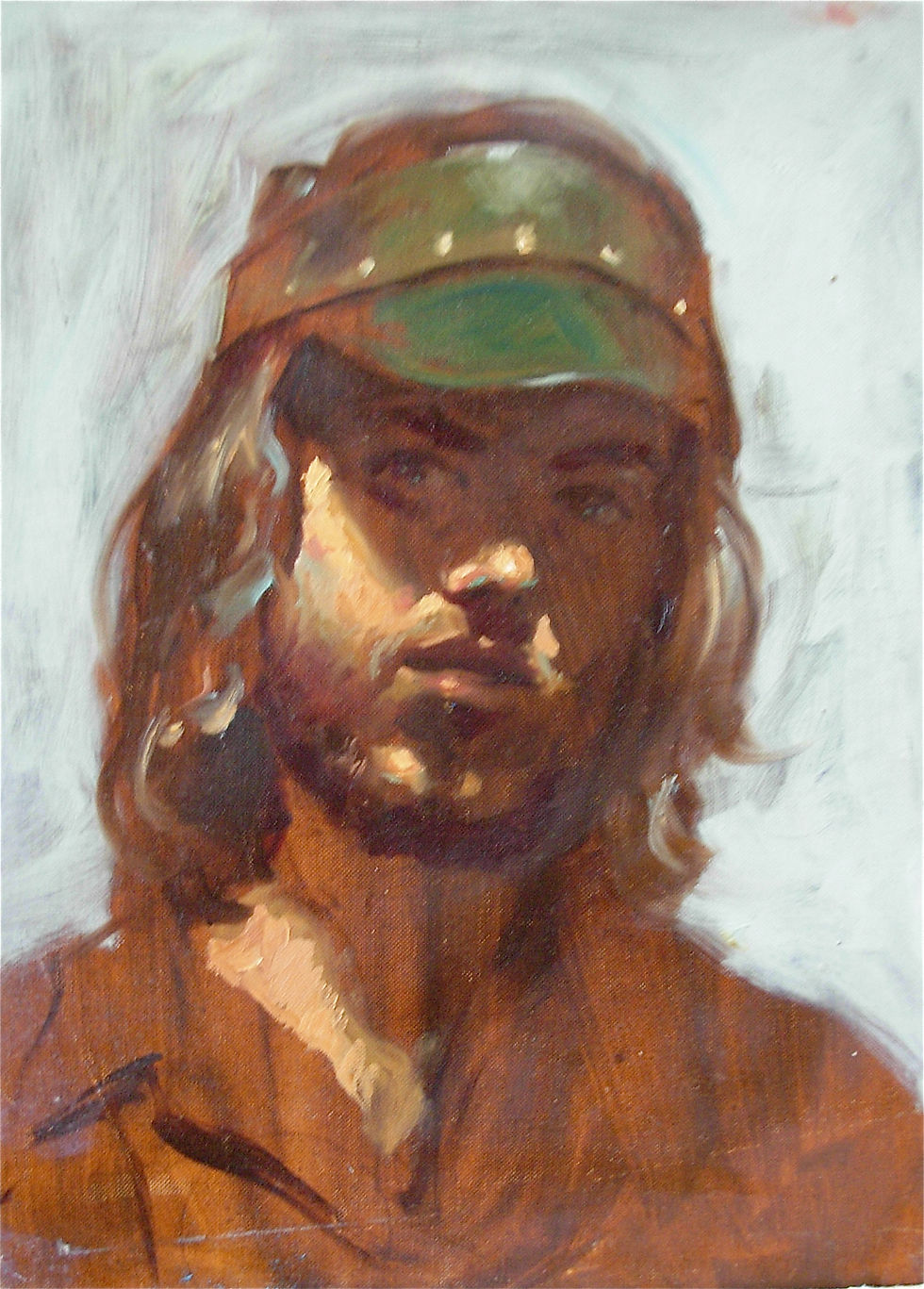
Above- A self portrait done from a mirror. This small head study (oil on canvas panel) dates from 1975, the year the artist graduated from the York Academy of Arts in York, PA.
In regards to the internal architecture of paintings there's a great book by Charles Bouleau titled, The Secret Geometry of Art where he breaks down the schematic structure of masterpieces. And to my delight, while painting this self-portrait I noticed a series of interlocking diagonals very similar to the system of slants that Bouleau illustrated at use in Rembrandt's painting of the Anatomy Lesson of Professor Tulp. A similar diagonal method of a parallelogram is used by Bruegel in his Parable of the Blind leading the Blind. In Bouleau's book one can easily find the author's geometric schemes overstated. So it was refreshing to read of Bouleau's reservations that Rembrandt's work seemed to resist these impositions of geometry. Still, it is intriguing to see how these geometries could be applied. Here's a quote from Bouleau's book:
To attempt to analyze pictures by Rembrandt may well be presumptuous. His way of composing a picture, like the texture itself, appears mysterious; it seems to escape every kind of contingent factor. His technique consisted of continual retouching, of sheer work, cuisine, and his conception was always supple, constantly changing, entailing such sacrifices of work already done that the final state of the picture was often far removed from its starting point.

Above- Charles Boulou, the author of The Painter's Secret Geometry designed this analysis of Rembrandt's painting of the Anatomy Lesson of Professor Tulp, showing the diagonal slants and crisscrossing rhythms. A similar diagonal armature is also part of the self portrait shown above- titled, An Interior- Sketching Time.
Bruegel's painting of The Parable of the Blind mentioned above uses a very similar diagonal armature as the Rembrandt. It incorporates two horizontal parallel lines that are crossed by other lines dividing the work into rhythmic junctures made by the intervals between the men.
Good to hear this as it suggests that the work was not merely filling in the blanks but an organic and evolving process of discovery with sometimes pentimenti, (the Italian term for covered up mistakes). Using a ruler, protractor or compass is not a substitute for looking, searching and creating.

Above- "I Brake for Afternoon Light'. In this wide-format panel, a 12" x 48" oil, includes a self portrait in the rearview mirror. . This painting captures the author's pursuit of the motif in the serendipitious light of the quotiidan. In this case, the inspiration happend while driving home- heading east, up State Street in Ithaca, NY
The self- portrait in painting may be like the autobiography in literature. We recall some of the major examples in this genre, like Saint Augustine's Confessions or Ben Franklin's autobiography- perhaps the first in the genre or another example woould be Joyce's Portrait of the Artist as a Young Man. These are all attempts to flesh out our inner selves. In this day of massive selfie proliferations we may be over-flooded with the attempt to the point of nausea.
The painting process or drawing is a prolonged endeavor and goes through many changes- in the work and in ourselves. This underscores the idea in painting of constantly getting a fresh look to help us with a re-evaluation. More objectivity, in other words.
A Mirror or A Stage-
Perhaps there is no final self, an ultimately definable visage or entity that we can finally call a done deal. The idea of Shakespeare's about life (life being a stage and we are but actors), is part of the attitude or idea here. Actors take on many roles that are part of themselves and not being attached to one persona has its appeal and benefits. The aversions of self are said to be an aspect of suffering. This idea was brought out wonderfully in a book by Tara Brach titled, Radical Self Acceptance. This idea of inner acceptance is also brought out in a small book by Roger Housden titled, How Rembrandt Reveals Your Beautiful Imperfect Self-: Life Lessons from the Master.
Rembrandt used a mirror for many of his dozens of self-portraits. I happen to be using photos for this current painting. This sidesteps the problem of showing us as southpaws from the inverted image (or using our opposite hand and having everything reversed). But this idea of mirroring ourselves is instructive. "Hold a mirror up to yourself"- as the saying goes. As a model, Rembrandt posed himself in various roles. You can see him peeking out from groups of figures in cameo roles or even placing himself at a crucifixion.
To end with a note about The Prodigal Son of Rembrandt (and others) as an example of forgiveness and self-acceptance seems apt here. Rembrandt's self-portraits seem to be visual records of this idea of self-knowledge and self- acceptance. Here's a passage from Housden's book:
In taking in our failings, our shortsightedness, whatever it is at heart- in embracing it- we transform it. In including it as part of who we are, we show an unselfconscious compassion for ourselves. The compassion is another name for forgiveness, and forgiveness is a theme that runs like a vein through Rembrandt's work.
And in regards to The Prodigal Son, Housden offers this:
There is a humility in holding no grudge; in accepting the son who has come home to you, whatever he may have done while away.

Above- a self-portrait- as part of a still life- circa 1992. This painting was made with the use of a mirror- from observation rather than from a photograph.

Above- A large-scale painting (36" x 56") of the Susquehanna River valley at Wyalusing, PA with a self-portrait. This work was inspried in part by a similar painting by Thomas Cole, the 19th century Amercan painter and leader of the Hudson River School of painters.


Comments