
Polemics- The Vertical Visual Vantage-
Updated: Nov 1, 2025
An ode to the telephone poles in our landscape- Brian Keeler
When we regard telephone poles, telegraph poles (if there are any left) and various other vertical infrastructures (if we even think much about them at all) they are merely necessary aspects of the towns, cities and countryside where we live and travel. They do have a visual component that we sometimes appreciate and sometimes disdain as intrusive. In this essay I will enterain how these vertical sturctures are incorporated into art.

Above- "4th of July Nocturne, Fleetville, PA"- a 36" x 40" oil by the author that incorporates telephone poles, a metal one and a wooden one as prominent elements in the design. Many modern poles for street lights and signs are made from aluminum. There are some thoughts on the environmental detriments to such wide-spread use of trees for posts in this article.

Above- This 18" x 48" oil was begun en plein air near Hammondsport, NY. It includes telephone poles and the lines. The vineyard posts also become part of vertical divisions of space, and they suggest depth and perspective. We could think of the repetition and spacing of verticals (and horizontals) as the equivalent of the rhythm in a song and perhaps the light as the harmony.
To view a video on the early stage of this work- go to this link; https://youtu.be/wtkCOxaQ_0Y?si=tPH3W8JD_fGmHP8h
"Poleology" and making a study of the commonplace
I am appropriating the term polemics here, usually used to denote opposing arguments if not outright hostile politics and ideologies. We all know too well that we are immersed in the latter up to our chins now with strident and divisive polemics spewing forth in heaps everyday. So this contemplation of the visual, ahem, polemics may offer a welcomed respite. And "poleology", is a word that I coined to suggest the study of these everyday features along roadsides.
I know and appreciate how these vertical posts in our picturesque towns and bucolic landscapes are more or less unavoidable. So the question comes up- to be inclusive creatively or edit artistically. To be truthful, I've done both and find merit in both approaches. And a reflection of many famous paintings and works of lots of artists working today show interesting and creative utilizations of the utility lines and infrastructure poles. Add to this consideration, other related vertical carriers and conduits of the energy grid like wind generators or even windmills of Rembrandt's era in 17th century Holland. Of course those ancient windmills now definitely come under the picturesque category. The modern versions coursing the sight lines of Pennsylvania mountain tops or on our ocean shore lines are another story- and debatable.
This essay was piqued by an article from the Financial Times (August 31, 20205) titled, Ode to the Telegraph Pole, by Deborah Nash. Apparently in Britain the lower slung telegraph poles still proliferate. Whereas here in the States only vestiges of these communication structures can be seen here and there. On a stretch of US Route 6 east of Laceyville, PA I recall seeing rows of these poles with remnants of sagging lines still there.
Above- This large studio painting by the author depicts a winter view of Homet's Ferry, PA with the inclusion of telephone poles and wires.
In regards to Britain, there were some surprising facts mentioned in the article by Nash. For example, there are 4.2 million telegraph poles in that island nation. So they are so ubiquitous as to be unavoidable. And these poles last a long time- one, still in use is documented as being 131 years in active duty. They go back to the 1840's. Then there's the environmental element coming from concern with how unrestrained their use is. There is apparently and understandably pushback- in the category of enough is enough. There is in the offing in the U.K. planning to have 620 more miles of telegraph poles installed by 20250. The other environmental aspect is the huge consumption of trees. Most of these poles come from Sweden and Finland, with 75,000 Scots pines felled each year- and some as old as 250 years.
And like the cloud appreciation society, which I plan to join someday, there is in the U.K. a group that promotes appreciation for the humble poles, called the Telegraph Pole Appreciation Society (TPAS). The T.P.A.S. founder, Martin Evans finds the visual contemplation of the poles a poetic delight. Even as a child he would imagine them in anthropomorphic visages. To inspire the membership of T.P.A.S. they offer a pole of the month award for the 1,300 members and the annual appreciation day approaches on the equinox, September 23.

Above- a nocturne of the Maine fishing village of Stonington on Deer Isle. This 18" x 20" oil on linen includes the telephone poles as part of the charm of the 19th century Main Street.
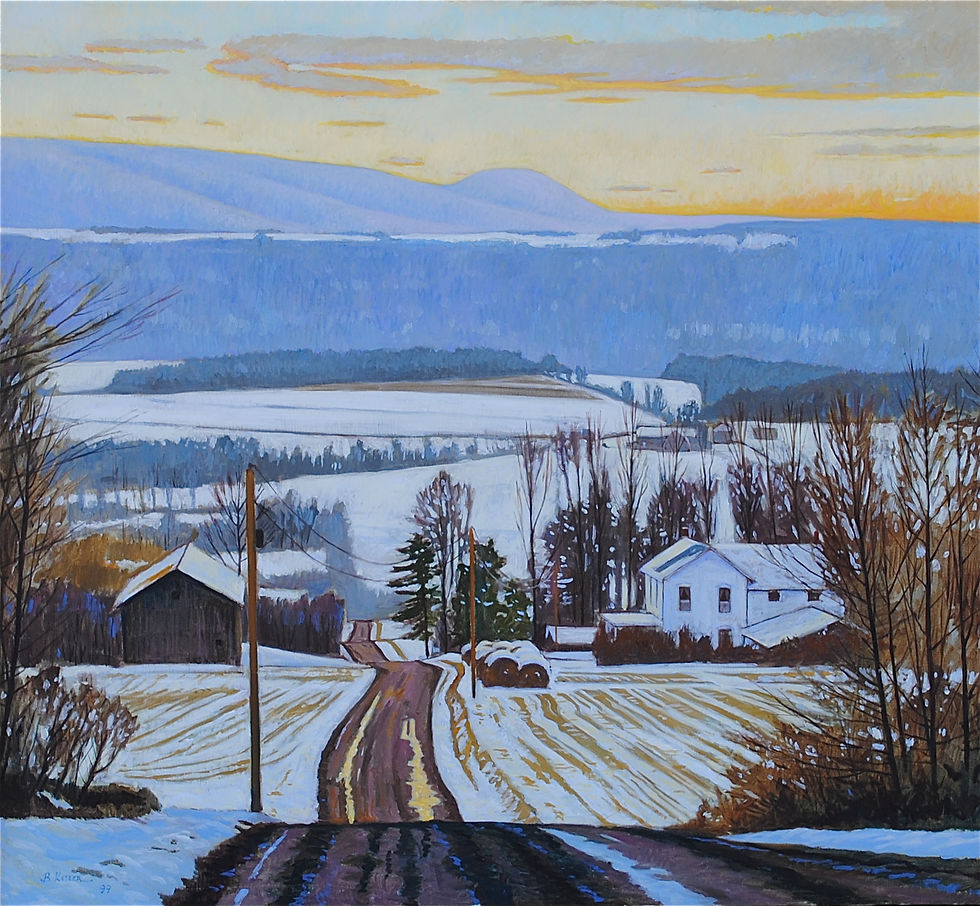
My interest in artistic "polemics" is how these vertical poles can be utilized to organize pictorial space in a painting. My first consideration in any painting is where the major horizontal and vertical divisions are. How the intervals of space are organized is the concern. And in a landscape or townscape with telephone or power line poles they can be worked with or struggled against. As an aside, a gallery owner that I know cautions against showing paintings with telephone poles and she's rejected canvases for this reason. Truth be told, the poles are not so difficult to portray, but doing the wires is another matter. This challenge is especially at play with the wires traversing a stretch of sky. Paint them too dark and too contrasty and they glare. So, their rendering is a delicate matter. I've seen some fine plein air paintings by artists that have whipped in the wires with very spontaneously and effective strokes of the brush. Rather than belaboring their painting, the wires are suggested with quick swishes of the brush. It works.
We can, by extenstion see the lessons that poles offer us in the landscapes into the works of famous artists, like Vermeer. There were no telegrpah poles back in the 16th century but the appreciation and use of verticals and horizontal intervals came into play. The interiors that he painted or in the masts of ships of Dutch marine painters all incorporate an apprecaiton for intervals. See the sketch below done at the Frick Museum in New York City.

Above- a graphite drawing done in New York City at the Frick Museum from a painting by Vermeer. The purpose of the sketch was to analyze the intervals- of the verticals, horizontals and diagonals.
At first consideration, the telephone pole may seem to be visual redundancy in the extreme. Like so many endless post without variation extending in perspective ad infinitum. And yes we can relate to that take. Like a road in the dessert of Utah or Nevada extending without incident through a featureless terrain. Yet, with a little study we can begin to flesh out the character and nuance of the pole. For example, birds roosting in visual pattern- a dozen or so on a lonely line. An osprey on another and perhaps we may hear refrains of the Witchita Lineman wafting through the air as we seek out character and charisma of these wooden sentinels.
To tilt or not to tilt, that is the question-
Tilting poles and crumbling buildings along with even sagging lines are part of the entropic inevitable decline of structures- and worth considering here. Yes, another aspect of artistic license is whether to render the poles in perfect geometric right angles or to really observe how slants and angles vary. I opt for the latter usually. But then we come to the framing process we encounter how the slants veer from the borders of the canvas- which according to some are the four most important lines. I like to consider how angles and slants vary from perfect verticals or horizontals. Say, how the perfect vertical of a house may be compared to the tilt of an adjacent pole.

Above- This 10" x 26" plein air oil of a section of Gloucester, MA next to the Mill River, includes leaning telephone poles.
To view a video of this painting being worked on at the end of the first session- go to this link; https://youtu.be/y559fXSlsvI?si=ttgFP2RqXnfRHGEH
There is at least one famous work by Edward Hopper that brings the above consideration into play. In his canvas, a view of streets with houses in Gloucester, MA the telephone pole is a dominant feature and it is left masterfully at an angle. An artist friend of mine, Earl Lehman, of Laceyville, PA has made the portrayal of telephone poles in landscapes almost his signature style. An example of Earl's work is shown below. In regards to poles in his painting Earl says, "Earl says, "The pole paintings address man on earth. " We might think of this inclusion of poles as representing the interface of nature and technology in the landscape.
I also think of Grant Wood and Thomas Hart Benton's paintings of mid-20th century landscapes with the telephone poles being intrinsic to the aesthetic and honesty of vision.

Above- a painting by Earl Lehman, an artist from Laceyville, PA (Wyoming County). This landscape, according to the artist, features telephone poles as a commentary on the problematic and destructive aspect of the human effects on the earth.

Above- Norman Rockwell's painting of lineman. This painting is part of the Norman Rockwell Museum in Stockbridge, MA. The telephone pole in this painting is rendered with amazing detail and the offset postion underscores the ideas exemplified in the Vermeer. This paitning dates from 1948 and was commissioned by an agency representing AT&T.
The polemics of poles on our landscapes or in our paintings may offer some levity and pure aesthetic release. With the "mathy" aspects of visual geometry I don't find this technological intrusion so daunting but rather a welcomed challenge. The poetic and lyrical relations of nature and manmade elements can be a springboard for blending the non-picturesque with the bucolic. I hope to be out there on the equinox (this is the U.K. appreciation day for telegraph poles, and we assume we can piggyback by honoring our American telephone poles) by paying homage to these humble vertical infrastructures, if only in passing on the way to a sunset.

Above- This large studio painting depicts a sunset over Seneca Lake, near Hector, NY with the inclusion of telephone poles and wires. It was begun as demo piece at the West End Gallery in Corning, NY. The title of this 18" x 48" oil on linen is "Spring Evening over Seneca"
To view a video recap of the demo- https://youtu.be/AkRqRg-I6xk?si=HhSd1uEvhTaOR2rZ

Above- "Spring Hill, Vernal Light". Oil on linen 42" x 46". This studio painting includes two telphone poles placed to the far right and they create a primary division of space combined wiht the stop signs.
Note - Most of the paintings in this article are available at the North Star Art Gallery in Ithaca, NY or at the West End Gallery in Corning, NY.
Post Script- A reader had this perspicacious observation in regards to the above essay-
Your observations--e.g., "The poetic and lyrical relations of nature and manmade elements can be a springboard for blending the non-picturesque with the bucolic"--call to mind the chorus of "Moonlight in Vermont," the 1944 hit whose embrace of "telegraph cables" seems improbable--nay, inimical--to the song's desired effect. "Telegraph cables, they sing down the highway / And travel each bend in the road / People who meet in this romantic setting / Are so hypnotized by the lovely...." The song nonetheless works, the soft natural details of its verses--penned in haiku--strangely enhanced by the industrial elements of its chorus.


Comments